
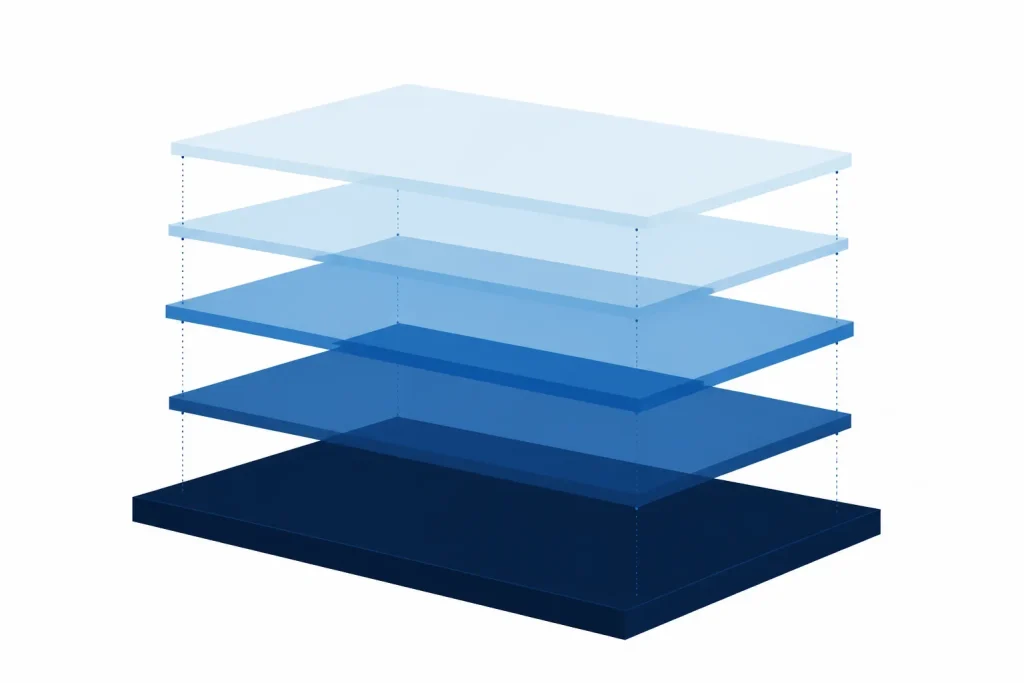
Pillar 2A is the firm-specific capital the PRA requires a bank or building society to hold on top of its Pillar 1 minimum, for risks Pillar 1 does not capture or does not capture fully, such as credit concentration and interest rate risk in the banking book. The PRA sets it after reviewing the firm’s ICAAP in the Supervisory Review and Evaluation Process (SREP), usually as a percentage of risk-weighted assets plus fixed add-ons, and Pillar 1 plus Pillar 2A makes up the firm’s Total Capital Requirement.
What is Pillar 2A for?
Closing the gaps in Pillar 1. SS31/15 paragraph 5.10 says the PRA looks at two things when it assesses a firm’s capital: risks “either not captured, or not fully captured” under the Rulebook, which it calls Pillar 2A, and risks the firm may become exposed to over a forward-looking planning horizon, which it calls Pillar 2B. Pillar 2A is a requirement the firm must meet at all times. Pillar 2B is covered by the PRA buffer, which sits on top.
How does the PRA set a firm’s Pillar 2A?
From two inputs: the firm’s own calculations in its ICAAP and the results of the PRA’s own methodologies, published in its statement of policy SoP5/15 (SS31/15 paragraphs 5.11 and 5.12). The PRA also takes account of how far the risks are mitigated by macroprudential buffers, and runs peer group reviews so that similar firms get consistent answers.
The result is usually expressed as a percentage of the firm’s Pillar 1 risk-weighted assets plus one or more fixed add-ons for specific risks (paragraph 5.16). If the firm agrees with its Total Capital Requirement it applies for a requirement under section 55M of FSMA to make it binding; if it does not apply, the PRA can impose one (paragraph 5.18). A firm that thinks the figure is wrong should say so, and if the two sides cannot agree the PRA can use its own-initiative powers (paragraph 5.25).
The firm’s own assessment carries weight only if it really is the firm’s own work. SS31/15 paragraph 2.1 says a firm “merely attempting to replicate the PRA’s own methodologies” is not carrying out the assessment the rules require, and SoP5/15 lists the quality of the firm’s Pillar 2A assessment among the factors the PRA considers (paragraph 4.9A).
Which risks does Pillar 2A cover?
| Risk | How the PRA approaches it | What changes on 1 January 2027 |
|---|---|---|
| Credit risk | Where the standardised approach underestimates risk, assessed against the firm’s portfolio | Benchmarking methodology, including the IRB benchmarks, removed; two systematic methodologies added, for government and central bank exposures and for retail unconditionally cancellable commitments; firms choose their own approach to idiosyncratic credit risk (PS15/26 paragraphs 2.1, 2.8 and 2.39) |
| Credit concentration | Concentrations in the loan book that the Pillar 1 formula does not reflect | No change in Phase 1 |
| Operational risk | For significant firms, three loss estimates (C1, C2 and C3) inform a supervisory judgement; conduct risk largely by supervisory judgement (SoP5/15 paragraphs 4.9D, 4.15 to 4.17A) | Method unchanged; clearer expectations on scenario analysis in the ICAAP (PS15/26 paragraph 3.1) |
| Pension obligation risk | The firm’s own stress testing of its defined benefit schemes | PRA-prescribed stress scenarios removed; no full FSA081 return for schemes fully bought-in or at least 130% funded (PS15/26 paragraphs 4.1 and 4.6) |
| Interest rate risk in the banking book | Named in SS31/15 as a Pillar 2A risk | No change in Phase 1 |
| Market and counterparty credit risk | Risks not fully captured by Pillar 1, including illiquid risks | More information published on the PRA’s methodology (PS15/26 chapter 5) |
The refined methodology, which offset part of the credit risk add-on for some firms, retires for everyone on 1 January 2027 (PS2/26 paragraph 1.11). Our operational risk capital page covers the C1 to C3 method and the scenario expectations in detail.
How does the PRA buffer relate to Pillar 2A?
It sits above it. After the SREP the PRA also tells the firm how much capital to hold as a PRA buffer, over and above its Total Capital Requirement and its combined buffer, so it can keep meeting the overall financial adequacy rule in a stress after realistic management actions (SS31/15 paragraph 5.20). The buffer is usually a percentage of Pillar 1 risk-weighted assets and the PRA expects it to be met entirely with CET1 capital (paragraph 5.23).
Where Pillar 2A and the PRA buffer sit in a firm's capital stack
Governance feeds straight into it. Where the PRA judges a firm’s risk management and governance to be significantly weak, it can set the PRA buffer to cover that weakness, generally as a scalar of up to 40% of the CET1 needed to meet the Total Capital Requirement, until the weaknesses are fixed (paragraph 5.22). A poor governance finding can therefore cost capital directly.
How is Pillar 2A changing with Basel 3.1?
In two ways. First, the PRA is rebasing firm-specific Pillar 2 so that the same risk is not capitalised in both Pillar 1 and Pillar 2A once Basel 3.1 applies, and during the output floor transition it will rebase variable Pillar 2A so that floor-driven increases in risk-weighted assets do not push it up where the risk is unchanged (PS9/24 paragraphs 6.2 and 6.11). The SME and infrastructure support factors leave Pillar 1 and come back as Pillar 2A lending adjustments (PS7/25).
Second, the first phase of the PRA’s Pillar 2A review, finalised in PS15/26 on 28 May 2026, changes the methodologies from 1 January 2027 as set out in the table. The PRA did not expect it to change Total Capital Requirements substantially in aggregate, but said the effect on individual firms will vary (paragraph 6.9). A second phase follows, and the PRA has said it will consider contingent FX risk there (PS1/26 paragraph 4.11). ICAAPs signed off from 1 January 2027 have to reflect all of it; our article on updating your ICAAP for Basel 3.1 covers what that means for the document.
How often is Pillar 2A reset?
At each capital SREP. SoP5/15 now says that for firms other than major UK firms the SREP cycle can be every two to four years, and the PRA can run an off-cycle review where material developments make the existing requirement inaccurate (PS15/26 paragraphs 6.11 and 6.12). Since October 2025 the PRA’s Scale-up Unit has offered out-of-cycle capital reviews to participating firms that are growing fast or whose business model has changed. For a growing lender, a Pillar 2A set on a smaller and different book can sit badly with the business plan, which is why the out-of-cycle option matters.
Is a firm’s Pillar 2A public?
The total is; the parts are not. The PRA expects firms to disclose the amount and quality of their Total Capital Requirement at the highest level of UK consolidation, and to treat its components and everything about the PRA buffer as confidential unless the law requires disclosure (SS31/15 paragraph 5.37). Firms should also share the SREP letter with their auditors.
Our Risk Advisory team writes and reviews the Pillar 2A sections of ICAAPs and prepares firms for the SREP conversation; see our ICAAP service, the ICAAP practitioner’s guide and, for the basics, what is an ICAAP. The RisKIT capital models calculate Pillar 2A and the buffers in open Excel. For a permanent lead on capital, see our head of prudential risk search. Terms are defined in our glossary.
Questions readers ask
What is the difference between Pillar 2A and Pillar 2B?
Pillar 2A covers risks Pillar 1 does not capture or does not capture fully, today. Pillar 2B covers risks the firm may face over its planning horizon, including in a stress, and the PRA addresses it through the PRA buffer (SS31/15 paragraphs 5.10 and 5.20).
Do small domestic deposit takers have Pillar 2A?
Yes, set with simplified methodologies in SoP5/25 for credit, credit concentration and operational risk. From 1 January 2027 an SDDT holds a Single Capital Buffer of at least 3.5% of risk-weighted assets in place of the PRA buffer and the conservation and countercyclical buffers (PS20/25 paragraph 1.14). Our SDDT page covers who qualifies.
Can a firm challenge its Pillar 2A?
Yes. SS31/15 paragraph 5.25 expects a firm that considers its proposed Pillar 2A or PRA buffer inappropriate to tell the PRA. If they still disagree after discussion, the PRA can impose its view using section 55M of FSMA.
Will our Pillar 2A fall when Basel 3.1 starts?
It depends where Basel 3.1 raises your Pillar 1. The PRA is removing double counting through its off-cycle review, but the Phase 1 changes can add requirements as well as remove them, and the PRA expects more firms to have Pillar 2A credit risk add-ons once the benchmarks go (PS15/26 paragraph 2.62).
Sources: PRA SS31/15, The ICAAP and the SREP (version effective 1 July 2026), paragraphs 2.1, 5.10 to 5.12, 5.16, 5.18, 5.20, 5.22, 5.23, 5.25 and 5.37; PRA SoP5/15, The PRA’s methodologies for setting Pillar 2 capital, paragraphs 4.9A, 4.9D and 4.15 to 4.17A; PRA PS15/26, Pillar 2A review Phase 1 (28 May 2026), paragraphs 2.1, 2.8, 2.39, 2.62, 3.1, 4.1, 4.6, 6.9, 6.11 and 6.12; PRA PS2/26 (20 January 2026), paragraph 1.11; PRA PS9/24 (12 September 2024), paragraphs 6.2 and 6.11; PRA PS7/25 (22 May 2025); PRA PS1/26 (20 January 2026), paragraph 4.11; PRA PS20/25 (28 October 2025), paragraph 1.14. Accessed 29 September and 1 October 2026.
How we research and check our articles: our editorial policy.