Recovery plan consultants: plans that stand up to the PRA
RiskTAE’s recovery planning service writes, refreshes or reviews the recovery plan of a UK bank, building society or lender against the PRA’s Recovery Plans Part and SS9/17. Practitioners who have run risk functions calibrate the indicators, value the options, run the scenarios and the fire drill, then hand the plan and its model to your team.
Your board approves a plan it has rehearsed and can call credible and executable, and your own people can keep it current.
A recovery plan sets out the measures a firm would take to restore its financial position after a significant deterioration. The PRA requires one under the Recovery Plans Part of its Rulebook, and its expectations on content sit in SS9/17, last updated on 26 March 2026 and effective from 1 April 2026.
It is the board’s document. The management body must oversee, assess and approve the plan before it goes to the PRA, and SS9/17 asks the board to state how far it considers the plan credible and executable. Recovery planning is a prescribed responsibility under the Senior Managers Regime.
Detail should reflect the size and complexity of the firm: a simple business model may have few recovery options, and the PRA accepts that, but still expects careful thought about what they are. The Rulebook requires a review at least annually, or at least every two years for an SDDT, a change recorded in the March 2026 update to SS9/17 following PS10/26, and the plan must be kept current when the business, its structure or its finances change materially.
Sources: PRA Rulebook, Recovery Plans Part, rules 2.2, 4.2 and 5.2; PRA SS9/17 Recovery planning, 26 March 2026, effective 1 April 2026, paras 2.4, 2.6A, 2.84 and 2.97, and the March 2026 annex.
Contents
What goes into the plan, and where do drafts fall short?
The right-hand column is what we find in drafts we review.
What SS9/17 expects in each part of a recovery plan
Part
What SS9/17 expects
Where drafts fall short
Recovery indicators
Qualitative and quantitative indicators, with early warning indicators ahead of them, each level justified against the credible options, the time they take and the buffers.
Indicators set at the risk appetite limits, so the first breach the board sees is already a recovery trigger.
Recovery options
A range broad enough to leave implementable options in different types of stress, suited to the business model, with disposals valued conservatively.
Options valued at book, several relying on the same buyer, and no view of how long each takes.
Scenario testing and recovery capacity
At least three scenarios for most firms, severe enough to test the plan, with capital and liquidity over time shown without and with the options, and recovery capacity in CET1, leverage ratio and LCR percentage points.
Profiles shown only after the options are deployed, or scenarios lifted from the ICAAP without a liquidity leg.
Governance and escalation
Clear escalation and decision-making, a stated point at which the PRA would be informed, and a board view on whether the plan is credible and executable.
An escalation route ending at a committee that does not meet in a stress.
Sources: PRA SS9/17, March 2026, paras 2.6, 2.10, 2.19, 2.39, 2.47, 2.51, 2.54, 2.57, 2.66, 2.80, 2.82 and 2.84.
Recovery indicators
How should recovery indicators be calibrated?
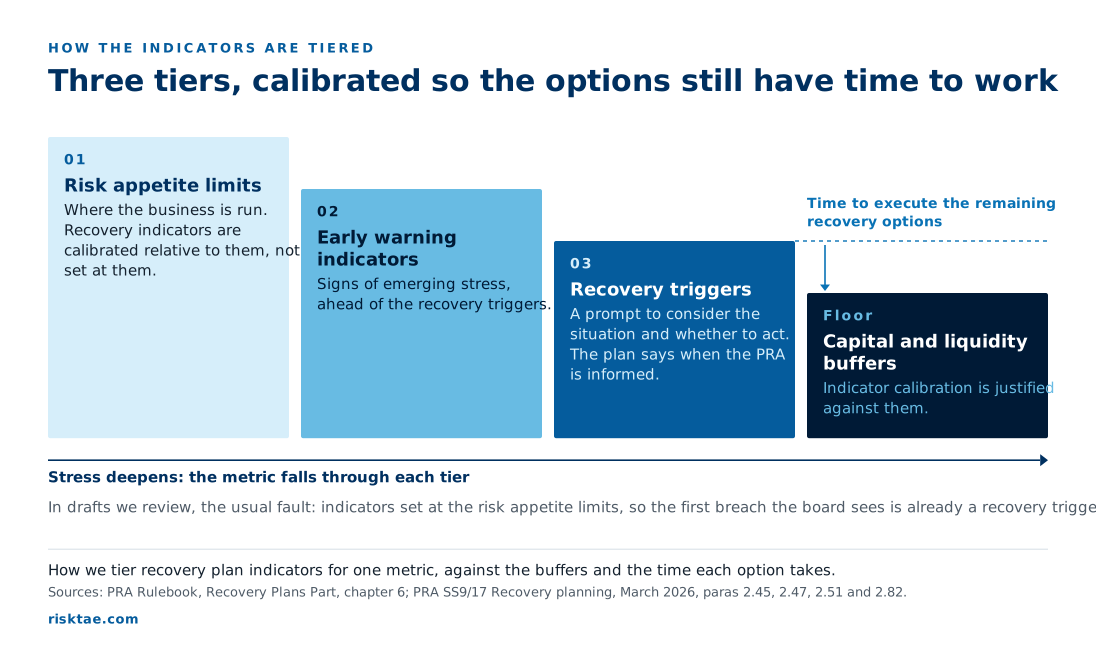
The Rulebook requires a monitoring framework of qualitative and quantitative indicators. SS9/17 treats a trigger as a prompt to consider the situation and whether to act, and expects early warning indicators ahead of the recovery triggers, so the board sees stress emerging rather than arriving.
Calibration has to be justified against the range of credible recovery options, the time they take to execute and, for capital and liquidity indicators, the relevant buffers. Where an option takes months to deliver, a trigger that fires once the firm is inside its buffers leaves no time to use it. The plan should also say at what point the PRA would be informed.
In drafts we review, the usual fault is indicators set at the risk appetite limits. We set the limits, the early warning indicators and the recovery triggers as separate tiers, then test each trigger against the scenarios.
Sources: PRA Rulebook, Recovery Plans Part, chapter 6; PRA SS9/17, March 2026, paras 2.45, 2.47, 2.51 and 2.82.
How the indicators are tiered
Three tiers, calibrated so the options still have time to work
How we tier recovery plan indicators for one metric, against the buffers and the time each option takes.
How is the plan tested before the board approves it?
Twice: on paper and in the room.
On paper, SS9/17 expects at least three scenarios for most firms, four for G-SIIs and O-SIIs and two under Simplified Obligations, each relevant to the business model and severe enough to test the plan. The plan shows capital and liquidity over time under each one, without the recovery options and then with them deployed, and the second run gives the recovery capacity in CET1, leverage ratio and LCR percentage points.
In the room, the PRA expects at least one fire drill before each submission, and at least one every three years, overseen by the board and involving the senior people who would use the plan. Where the full plan is too long to use in a stress, SS9/17 asks for a concise playbook that senior management can pick up.
We run the drill as a timed exercise against a tested scenario and record what it changed for the board pack. Directors who want to prepare first can take a session from Risk Education.
Sources: PRA SS9/17, March 2026, paras 2.39, 2.54, 2.57, 2.66, 2.72, 2.73, 2.76 and 2.77.
How we help
What can we do for your recovery plan?
Take one, or combine them.
01
Write or refresh the plan
We hold the pen: options identified with your executives, indicators calibrated, scenarios run, the fire drill held, and the plan and playbook taken through the risk committee to the board. Your team works alongside us, so the next review is theirs.
02
Review and challenge a draft
You keep the pen. We test the draft and its model against the Recovery Plans Part and SS9/17 and give the board a written gap report, each gap ranked by how likely the PRA is to raise it, with the fix.
03
Model the indicators and options
Where the model is the weak point, we start from RisKIT model 900, our pre-built recovery and resolution planning tool in open Excel, every formula visible, under a perpetual licence, set up and validated on your data.
04
Prepare the solvent exit analysis
For non-systemic banks and building societies, the solvent exit analysis the Rulebook requires as part of normal business, and the execution plan if an exit becomes a reasonable prospect.
Solvent exit
Does solvent exit planning sit with the recovery plan?
Solvent exit rules for non-systemic banks and building societies
Since 1 October 2025, chapter 7 of the Recovery Plans Part has required a UK bank or building society that is not, and is not part of a group that is, a G-SII or an O-SII, and is not subject to the Operational Continuity Part, to prepare for a solvent exit: ceasing its PRA-regulated activities while remaining solvent. The chapter sits inside the Recovery Plans Part and asks for its own analysis.
The business-as-usual requirement is a solvent exit analysis, updated on material change and at least once every three years, covering the exit actions and indicators, barriers and risks, resources and costs, communication, governance and decision-making, and assurance. An execution plan is only needed when there is a reasonable prospect that the firm may need to exit, or when the PRA asks for one.
Sources: PRA Rulebook, Recovery Plans Part, chapter 7, rules 7.1 to 7.4, effective 1 October 2025; PRA SS2/24, 12 March 2024, paras 1.2, 1.3, 2.1, 2.2, 3.3 and 3.4.
Credentials
Who does the work?
The work is led by Mark Dougherty, CPA (CAN), our technical lead, and done by senior practitioners who have held the roles: former CROs and heads of risk, former regulators and interim executives, with model and quant specialists.
Our people write, test and review recovery plans, solvent exit analyses and wind-down plans, and rehearse the decisions with the board and the executives who would carry them out. The same practitioners work across Risk Advisory.
FAQ
Questions about recovery planning
How often does a recovery plan have to be reviewed?
At least annually under the Recovery Plans Part, and at least every two years for an SDDT, a change recorded in the March 2026 update to SS9/17 following PS10/26. It must also be kept current when the firm’s structure, business or finances change materially.
Should the contingency funding plan be part of the recovery plan?
The PRA strongly encourages firms to combine the liquidity contingency plan, also known as the contingency funding plan, and the recovery plan into one integrated document (SS24/15, January 2026, para 2.40A). We build both on the same indicators and scenarios, so the ILAAP and the recovery plan tell one story.
How many scenarios does a recovery plan need?
At least three for most firms, four for G-SIIs and O-SIIs, and two under Simplified Obligations (SS9/17, March 2026). Each must be severe enough to test the plan and show capital and liquidity over time, first without the recovery options and then with them, which gives the board the firm’s recovery capacity.
Can you review a recovery plan we have already written?
Yes. We test the draft and its model against the Recovery Plans Part and SS9/17 and give the board a written gap report before it approves the plan.
Recovery indicators are the capital, liquidity, profitability and asset quality measures a bank sets in its recovery plan to warn that it is moving towards a stress in which recovery options may be needed. SS9/17, last updated in March 2026, expects them calibrated to the firm's own buffers and tested against severe scenarios.
A solvent exit analysis is the PRA's requirement for a non-systemic UK bank or building society to show how it could stop its PRA-regulated activities in an orderly way while still solvent. Chapter 7 of the Recovery Plans Part has applied since 1 October 2025, with the PRA's expectations set out in SS2/24.
The ICAAP is a bank’s own assessment of whether it holds enough capital for its risks; the ILAAP asks the same question of its liquidity and stable funding. The two sit in different Parts of the...
By Mark Dougherty, CPA (CAN) · 7 min read
Next step
Scope your recovery plan in 30 minutes
Tell us when the plan is due and where it stands. We will tell you what it would take to make it credible and executable, and whether you need us to write it, review it or model it.