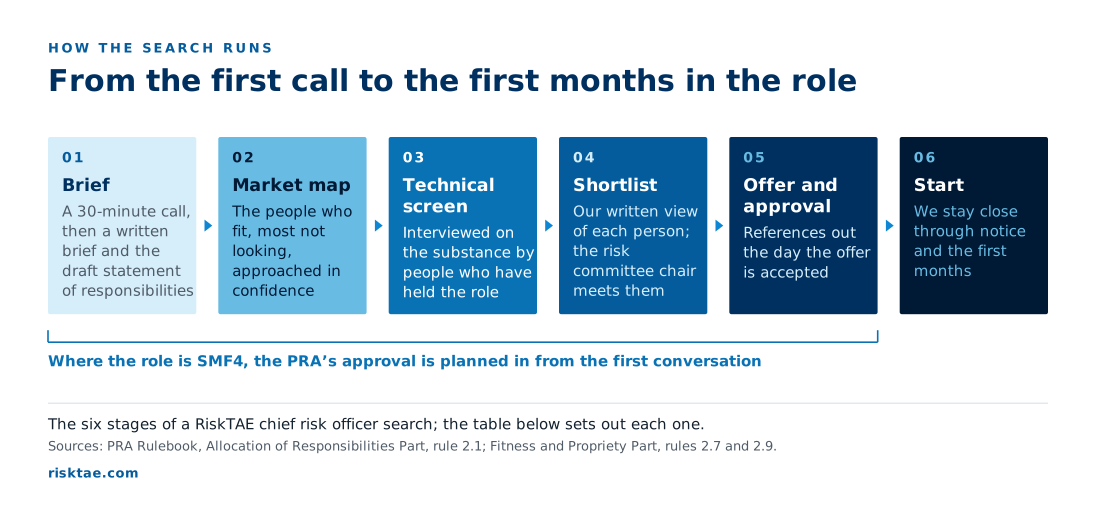
The PRA says there is no single right background for a senior manager, and since April 2026 its assessment takes account of approvals in other jurisdictions and SMF experience elsewhere. Before applying, the firm must satisfy itself that the person is fit and proper on personal characteristics, competence, knowledge and experience, qualifications and training; we build the shortlist on the same headings.
A first CRO for a growing lender usually comes from deputy CROs and heads of credit or prudential risk who have written an ICAAP rather than reviewed one; an established bank looks at sitting CROs and heads of risk at larger firms. The weakness we test hardest is scale: a specialist from a large bank has run one risk type with a big team, while in a firm with gross total assets of £250 million or less, where the PRA expects few senior managers beyond the mandatory ones, the CRO may be the only risk SMF and carry every risk type with a handful of people.
Whoever you appoint now will hold the role through the first year of the PRA’s Basel 3.1 rules, in force from 1 January 2027, so every candidate is asked what they did the last time the capital rules changed.
Sources: PRA Rulebook, Fitness and Propriety Part, rules 2.1 and 2.6; PRA PS12/26, 22 April 2026, paragraphs 2.16 to 2.21; SS28/15, April 2026, paragraph 2.7; PRA PS1/26, 20 January 2026.