Risk Talent · Interim

Interim chief risk officers: CRO cover at short notice for banks and lenders

An interim chief risk officer is a senior risk executive who holds the chief risk officer role for a defined period, usually while a bank or lender searches for a permanent appointment. RiskTAE places interim CROs in UK banks, building societies and lenders at short notice, choosing from people who have held the role.

You get someone who has done the job before, in post while the permanent search runs, with the approval paperwork handled alongside.

SMF4The PRA’s Chief Risk function
12 weeksThe window in the PRA’s rule on temporary cover for an absent senior manager, which PS12/26 changed from 24 April 2026

When you need one

When does a bank need an interim chief risk officer?

Most interim placements begin with a resignation that takes effect at once, an illness, or a permanent search that will not finish before the incumbent leaves.

The function cannot sit empty meanwhile: the Risk Control Part requires the head of the risk management function to be an independent senior manager who can report directly to the board and warn it. Speed matters, but so does fit: the interim inherits the risk committee and whatever made the last CRO leave.

Source: PRA Rulebook, Risk Control Part, 3.4 and 3.5.

Candidates

What does a strong interim CRO look like, and where do they come from?

The strongest interims have held SMF4, or a deputy CRO or head of risk role, at a firm of similar size and business model.

The PRA says there is no single right background, and its assessment now takes account of previous approvals and SMF experience elsewhere. Before applying, the firm must satisfy itself on the person’s personal characteristics, competence, knowledge and experience, qualifications and training. We screen on the same headings, with interviews run by people who have held these roles: former chief risk officers and heads of risk, former regulators and interim executives.

Career interims bring paperwork of their own: regulatory references must cover the previous six years and be sought from every relevant former employer, so five short assignments mean five references, each inside a four-week reply window that now binds all firms. We start that list before the offer.

An interim placed now holds the function when the PRA’s Basel 3.1 rules take effect on 1 January 2027, so we ask each candidate to walk us through the last capital plan they wrote.

Sources: PRA PS12/26, 22 April 2026, 2.16 to 2.21 and 2.79; PRA Rulebook, Fitness and Propriety Part, 2.1, 2.6 and 2.7; PRA SS28/15, April 2026, 6.4 and 6.5; PRA PS1/26, 20 January 2026.

Process

How does an interim CRO placement run?

Stages of an interim CRO placement
StageWhat happensAlongside
BriefA 30-minute call, then a written brief: role, deliverables, terms, timetable.We agree the dates that matter: the start, the application and the permanent hire.
Market mapPeople who have held the role, most not looking, approached in confidence without naming you.We ask each about the six years the references will cover.
Technical screenEach candidate is interviewed on the substance of the role, by people who have held it, before you see a CV.The firm must be satisfied the person is fit and proper before it applies.
Shortlist and offerOur written view of each person, interviews both ways, then an offer and a start date set around the approval.The Senior Manager Conduct Rules apply from the day the person performs the function.
ApplicationThe statement of responsibilities, six-year references and a criminal record check no older than six months at submission.In as early as possible; the regulator then has three months, and the clock stops while it waits for information.
HandoverThe interim writes the handover for the permanent CRO; the FCA’s rules say it should carry judgement and opinion, not just facts and figures.We stay close through the assignment and the handover.

Sources: PRA Rulebook, Allocation of Responsibilities Part, 2.1; Fitness and Propriety Part, 2.1, 2.7 and 2.9; FCA Handbook, SUP 10C.10 and SYSC 25.9; PRA PS12/26, 22 April 2026, 2.4.

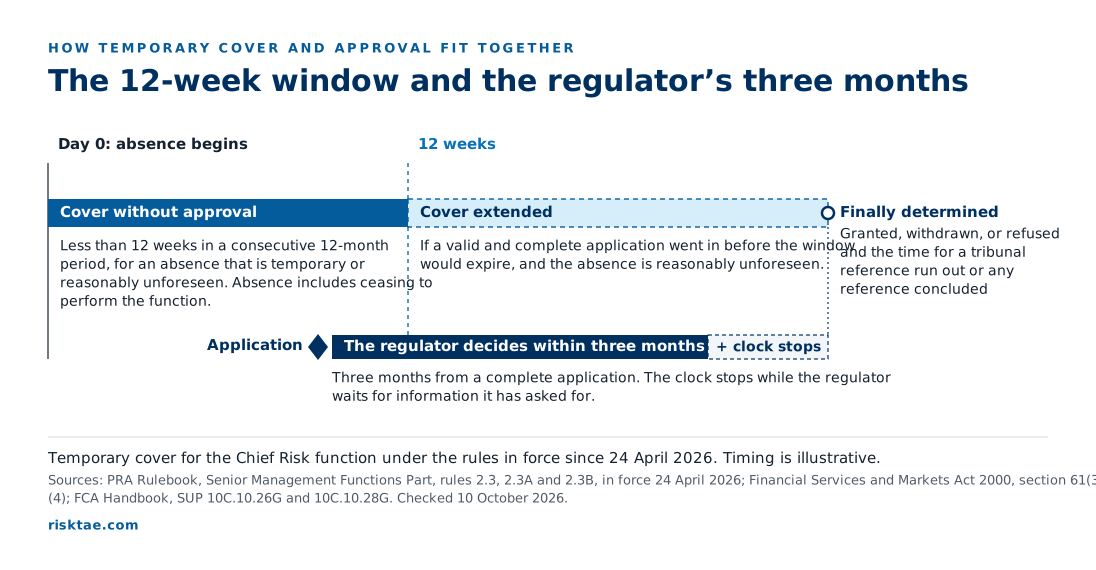
How temporary cover and approval fit together

The 12-week window and the regulator’s three months

The 12-week rule and SMF4 approvalA timeline of temporary cover for the Chief Risk function and the approval that follows, under the PRA’s Senior Management Functions Part as in force from 24 April 2026. Day 0: the SMF4 holder is absent, which includes ceasing to perform the function; the absence must be temporary or reasonably unforeseen. Temporary cover without approval is allowed for less than 12 weeks in a consecutive 12-month period. If a valid and complete application for approval is made before that window would expire, and the absence is reasonably unforeseen, the window extends until the application is finally determined. The regulator has three months from a complete application to decide, and the clock stops while it waits for information it has asked for. The application is finally determined when it is granted or withdrawn, or, if refused, when the time for a tribunal reference has run out or any reference is concluded. Timing in the drawing is illustrative.Day 0: absence begins12 weeksCover without approvalCover extendedLess than 12 weeks in a consecutive 12-monthperiod, for an absence that is temporary orreasonably unforeseen. Absence includes ceasing toperform the function.If a valid and complete application went in before the windowwould expire, and the absence is reasonably unforeseen.ApplicationThe regulator decides within three months+ clock stopsThree months from a complete application. The clock stops while the regulatorwaits for information it has asked for.Finally determinedGranted, withdrawn, or refusedand the time for a tribunalreference run out or anyreference concluded The 12-week rule and SMF4 approvalA timeline of temporary cover for the Chief Risk function and the approval that follows, under the PRA’s Senior Management Functions Part as in force from 24 April 2026. Day 0: the SMF4 holder is absent, which includes ceasing to perform the function; the absence must be temporary or reasonably unforeseen. Temporary cover without approval is allowed for less than 12 weeks in a consecutive 12-month period. If a valid and complete application for approval is made before that window would expire, and the absence is reasonably unforeseen, the window extends until the application is finally determined. The regulator has three months from a complete application to decide, and the clock stops while it waits for information it has asked for. The application is finally determined when it is granted or withdrawn, or, if refused, when the time for a tribunal reference has run out or any reference is concluded. Timing in the drawing is illustrative.Absence beginsThe SMF4 holder is absent, which includesceasing to perform the function. The absencemust be temporary or reasonably unforeseen.Cover without approvalTemporary cover for less than 12 weeks in aconsecutive 12-month period.Application madeA valid and complete application for approval,made before the window would expire.Cover extendedWhere the absence is reasonably unforeseen,the window extends until the application isfinally determined.The regulator decidesThree months from a complete application;the clock stops while it waits for information ithas asked for.Finally determinedGranted, withdrawn, or refused with the timefor a tribunal reference run out or anyreference concluded.

Temporary cover for the Chief Risk function under the rules in force since 24 April 2026. Timing is illustrative.

Sources: PRA Rulebook, Senior Management Functions Part, rules 2.3, 2.3A and 2.3B, in force 24 April 2026; Financial Services and Markets Act 2000, section 61(3A) and (4); FCA Handbook, SUP 10C.10.26G and 10C.10.28G. Checked 10 October 2026.

Download the diagram (SVG)

Failure points

What usually goes wrong with interim CRO cover?

  • Interim cover is planned for a departure the firm could see coming. A retirement agreed a year ahead or a resignation on five months’ notice needs a permanent search now, with an approved successor in place before the leaving date.
  • The application waits for the last reference. Where a reference has not arrived, explain in the application why it could not be obtained rather than hold the application back.
  • The interim is treated as a caretaker. The head of the risk function must be able to report directly to the board in its supervisory function, independent of senior management, and must not be removed without the board’s prior approval. An interim kept out of the risk committee cannot do that job.
  • The map is left as it was. Where nobody performs the Chief Risk function, the rules require responsibility for the compliance of the firm’s risk management systems, policies and procedures to go to another senior manager, and the management responsibilities map must stay current. We ask who holds it during the gap.

Sources: PRA SS28/15, April 2026, 6.22 to 6.23 and Table H; PRA Rulebook, Risk Control Part, 3.4 and 3.5; Allocation of Responsibilities Part, 4.2(2) and 7.1.

Working with your team

How does interim cover fit with the permanent search and your own team?

The interim placement and the permanent search run side by side, from the same brief and market map, with one partner accountable for both.

Decide at the brief whether the interim may be considered for the permanent role: some firms want that option, others want an interim with no stake in the outcome, and the answer changes who will take the assignment. Our chief risk officer search page covers the permanent process; the Risk Talent hub covers the other roles.

With HR, in-house talent acquisition and RPO teams we split the work: they own the process and the contract; we bring the market map and the technical screen. See how we work with talent acquisition teams.

Under the PRA’s rules the chair of the risk committee safeguards the independence of the risk function and oversees its performance, the CRO included, so the chair should meet the interim before the start, not at the first committee. The same firm does advisory and training, so interim cover can be paired with an independent review of the ICAAP through Risk Advisory, or training for the team the interim inherits through Risk Education.

Sources: PRA Rulebook, Allocation of Responsibilities Part, 4.1(17); PRA SS28/15, April 2026, Table F; PRA SS5/16, July 2018, 4.3.

Cost

What does an interim chief risk officer cost?

An interim CRO is paid a day rate agreed before the start, and the rate moves with the size and complexity of the firm and with whether the person will hold SMF4. We give you a range for your firm on the first call.

FAQ

Questions about interim chief risk officers

What is the 12-week rule?

A PRA rule that can allow temporary cover for a senior management function, the Chief Risk function included, while an approval is sought, under conditions. PS12/26 changed how it works from 24 April 2026, and our article on the 12-week rule sets the conditions out. Whoever performs the function is held to the Senior Manager Conduct Rules from the first day, and our SMF4 approval timeline planner works out the approval dates for your case.

How long can an interim CRO stay?

For as long as you and the interim agree, within whatever approval the regulator gives; the PRA has said approval of an interim appointee could be time-limited. In practice the permanent search sets the end date.

Our CRO is retiring next year. Do we need an interim?

Usually not. A departure you can see coming needs a permanent search, with the successor approved before the leaving date; the PRA’s 12-week rule does not cover a vacancy that could be anticipated.

Do you supply interim cover below chief risk officer?

Yes. We supply interim heads of risk, interim risk managers and day-rate specialists in models, credit, operational risk and regulatory change, in the UK and worldwide. See interim and contract risk professionals.

Next step

Has your CRO resigned, or is a leaving date set?

Tell us the date and whether the departure was foreseen. In 30 minutes we will tell you who could step in, whether the 12-week rule applies and what the application needs.

Brief us on a role

Tell us about the role and a partner will come back to you. Treated in confidence.

For example Chief risk officer (SMF4)

What kind of hire?

PDF or Word, up to 2 MB

Prefer email? talent@risktae.com or +44 20 3996 9599. We use these details only to reply to you: privacy notice.