Wind-down plans and solvent exit planning that would work on the day
RiskTAE writes, tests and reviews wind-down plans for FCA investment firms, payment and e-money firms, and the solvent exit analyses the PRA now requires of non-systemic banks, building societies and insurers.
Practitioners who have run risk functions build the plan from a real trigger, cost the exit, set the indicators and rehearse the decision with the board, then hand the plan and its model to your team.
Your board approves a plan that starts from stress, counts every resource the exit would still consume, and names the point at which it decides.
1 October 2025PRA solvent exit rules for banks and building societies
30 June 2026PRA solvent exit rules for insurers
Every three yearsMinimum update of a solvent exit analysis
Definition
What is a wind-down plan, and how does it differ from a recovery plan?
A wind-down plan sets out how a firm would stop its regulated business in an orderly way, with the least harm to customers and the market, if it could no longer carry on. The FCA’s Wind-down Planning Guide describes it as a process in which the governing body identifies the steps and resources it needs to wind down the business, especially where resources are limited, and evaluates the risks and impact of a wind-down and how to mitigate them.
A recovery plan answers a different question: how the firm would restore its position and keep trading. The two plans share indicators and scenarios, and building both on one model keeps them consistent, but the wind-down plan assumes recovery has failed or the owners have chosen to exit.
The PRA uses the term solvent exit for the same idea applied to banks, building societies and insurers: ceasing PRA-regulated activity while remaining solvent, so that the exit does not need the resolution authority.
What does the FCA expect of an investment, payment or e-money firm’s wind-down plan?
For a MIFIDPRU investment firm the plan is part of the ICARA: MIFIDPRU 7.5.7R requires the firm to identify the steps and resources an orderly wind-down would need and to evaluate the harms it would cause, and the liquid assets and own funds the wind-down would consume feed the firm’s threshold requirements. The Wind-down Planning Guide applies to FCA solo-regulated firms more widely, including payment and e-money institutions, and it is the FCA’s statement of what a good plan looks like.
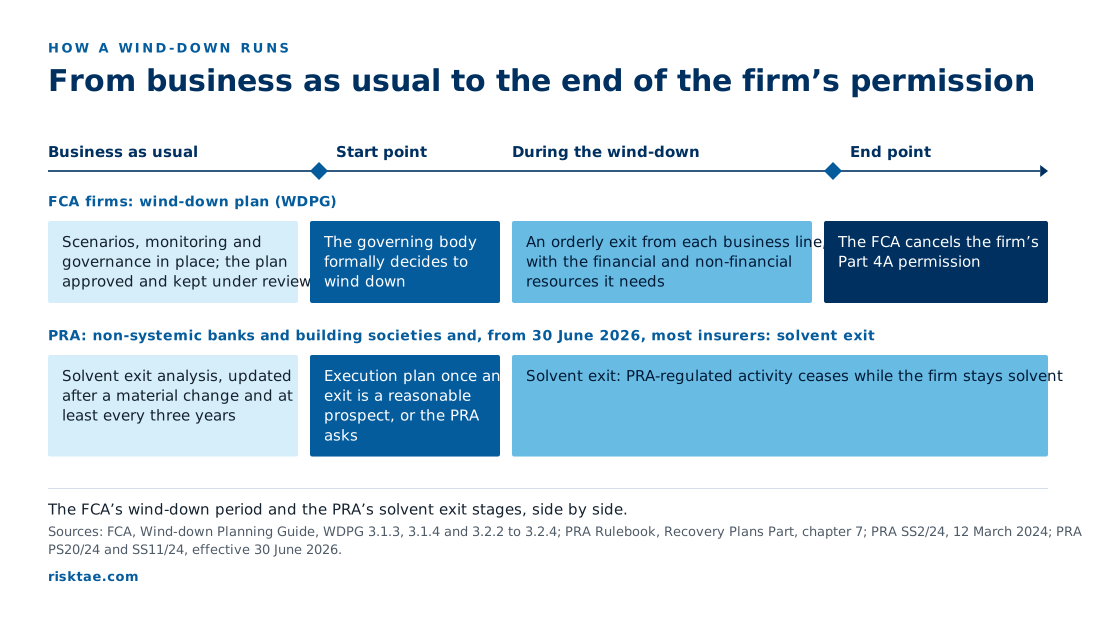
The guide sets the plan’s boundaries. It starts when the governing body takes the formal decision to wind down and ends when the FCA cancels the firm’s Part 4A permission. In between it expects the scenarios that could make the firm unviable, the governance and monitoring that would spot them, an ordered exit from each line of business, the financial and non-financial resources needed, and the risks to customers and how they are mitigated. The plan is approved by the governing body, and a named person keeps it under review.
When the FCA reviewed firms’ first IFPR assessments it found wind-down estimates built without a starting scenario of stress or a sudden trigger event, and group dependencies left out, so the resources needed were understated. Those two faults are where we start every review.
What does the PRA require of a non-systemic bank’s solvent exit analysis?
Chapter 7 of the Recovery Plans Part in force
Since 1 October 2025, chapter 7 of the Recovery Plans Part has required a UK bank or building society that is not, and is not part of a group that is, a G-SII or an O-SII, and is not subject to the Operational Continuity Part, to prepare for a solvent exit as part of normal business. SS2/24 sets out the PRA’s expectations.
The business-as-usual document is a solvent exit analysis. It covers the exit actions the firm could take, the indicators that would prompt them, the barriers and risks to an exit, the resources and costs it would need, communication, governance and decision-making, and the assurance over all of it. It is updated after any material change and at least once every three years.
A solvent exit execution plan is a second document, needed only when there is a reasonable prospect that the firm may need to exit, or when the PRA asks for one. The analysis is what makes that plan possible to write at speed, which is why the PRA wants it done while the firm is healthy.
In December 2024 the PRA published PS20/24 and SS11/24, extending solvent exit planning to insurers. The rules and the supervisory statement apply from 30 June 2026 to PRA-regulated insurers, with firms in passive run-off, UK branches of overseas insurers and Lloyd’s managing agents outside the scope.
The structure mirrors the banking rules. A solvent exit analysis, prepared as part of normal business and covering actions, indicators, barriers and risks, resources and costs, communication, governance and assurance, updated after any material change and at least every three years. Then a solvent exit execution plan, only if a solvent exit becomes a reasonable prospect, produced within a timescale agreed with the PRA or on its request.
For an insurer the analysis draws on the same engine as the ORSA: the solvency projection, the stress scenarios and the own funds the exit would need to hold until the last policy is run off or transferred.
What can we do for your wind-down or solvent exit plan?
Take one, or combine them.
01
Write the plan or analysis
We hold the pen: the trigger scenarios, the ordered exit from each business line, the resources and costs through to the last customer, the indicators and the decision point, written for the governing body and tested before it approves.
02
Review and challenge a draft
You keep the pen. We test the draft against the Wind-down Planning Guide and MIFIDPRU 7, or against the Recovery Plans Part and SS2/24 or SS11/24, and give the board a written gap report ranked by how likely the regulator is to raise each point.
03
Cost the exit
A model of the wind-down in open Excel: staff, premises, systems, contracts, intragroup services, customer transfers and the capital and liquidity they consume month by month, built on the same numbers as your ICARA, ICAAP or ORSA. For payment and e-money firms, RisKIT model 1100 holds the capital and wind-down calculation.
04
Rehearse the decision
A timed exercise with the board and the executives who would run the exit: what they would see, when they would decide, who they would tell. The record goes in the board pack and the next version of the plan.
Credentials
Who does the work?
The work is led by Mark Dougherty, CPA (CAN), our technical lead, and done by senior practitioners who have held the roles: former chief risk officers and heads of risk, former regulators and interim executives, with model and quant specialists.
The same team writes recovery plans, ICAAPs and ILAAPs for banks and ICARAs for investment firms, so the wind-down plan sits on numbers the board has already seen. The team works across Risk Advisory.
FAQ
Questions about wind-down and solvent exit planning
Is a wind-down plan the same as a solvent exit analysis?
They answer the same question for different regulators. The FCA asks solo-regulated firms for a wind-down plan under the Wind-down Planning Guide and, for investment firms, MIFIDPRU 7. The PRA asks non-systemic banks and building societies, and from 30 June 2026 most insurers, for a solvent exit analysis as part of normal business and an execution plan if an exit becomes a reasonable prospect.
How often must a solvent exit analysis be updated?
After any material change to the business that may affect preparations for a solvent exit, and at least once every three years, for banks under chapter 7 of the Recovery Plans Part and for insurers under the rules introduced by PS20/24.
Which insurers are outside the PRA’s solvent exit rules?
Firms in passive run-off, UK branches of overseas insurers and Lloyd’s managing agents, according to PS20/24.
Can you review a plan we have already written?
Yes. We test it against the relevant rules and guidance and give the board a written gap report before it approves the plan.
A wind-down plan sets out how an FCA-regulated firm would close its business in an orderly way, with enough money and people to return client assets and settle what it owes without harming customers or markets. This template follows the FCA's Wind-down Planning Guide section by section, with the MIFIDPRU and payments rules that sit alongside it.
A solvent exit analysis is the PRA's requirement for a non-systemic UK bank or building society to show how it could stop its PRA-regulated activities in an orderly way while still solvent. Chapter 7 of the Recovery Plans Part has applied since 1 October 2025, with the PRA's expectations set out in SS2/24.
An ICARA, or Internal Capital Adequacy and Risk Assessment, is the process an FCA investment firm under MIFIDPRU uses to identify the harms its business could cause, decide the own funds and liquid assets it needs to cover them and to wind down in an orderly way, and record the result for its board and the FCA.
By Mark Dougherty, CPA (CAN) · 9 min read
Next step
Scope your wind-down plan in 30 minutes
Tell us which regulator you answer to and when the plan is due. We will tell you what it would take to make it credible, and whether you need us to write it, review it, cost it or rehearse it.